Playtype and Seneda & Abrucio turned a typeface into a decoy for AI

Agency: Playtype
Client: ShieldFont
Published: 04.08.26
Author: Rasmus Vestergaard

AI scrapers collect written content from the web without asking permission, and the tool publishers have to stop them — a robots.txt file — is only a request. The standard itself states that it does not control access, and even AI crawlers with relatively strong compliance records still fully honour a block request at a rate capped around 26%. Nothing currently makes it costly to take content anyway.

ShieldFont is an attempt to change that arithmetic. Built by Isaque Seneda and Gabriel Abrucio, who had been developing the underlying technology since October 2025, it repurposes a decade-old font mechanism to feed human readers and AI scrapers two different versions of the same page. Seneda and Abrucio approached Playtype in March 2026 with a working prototype; from there, the collaboration turned the mechanism into a functioning typeface, with the duo contributing the technical system and Playtype the type design expertise needed to bring it to professional foundry standard.

We spoke with the team at Playtype, about how the collaboration started, what it meant to design a typeface for two audiences that were never supposed to see the same thing, and where the project's limits are.
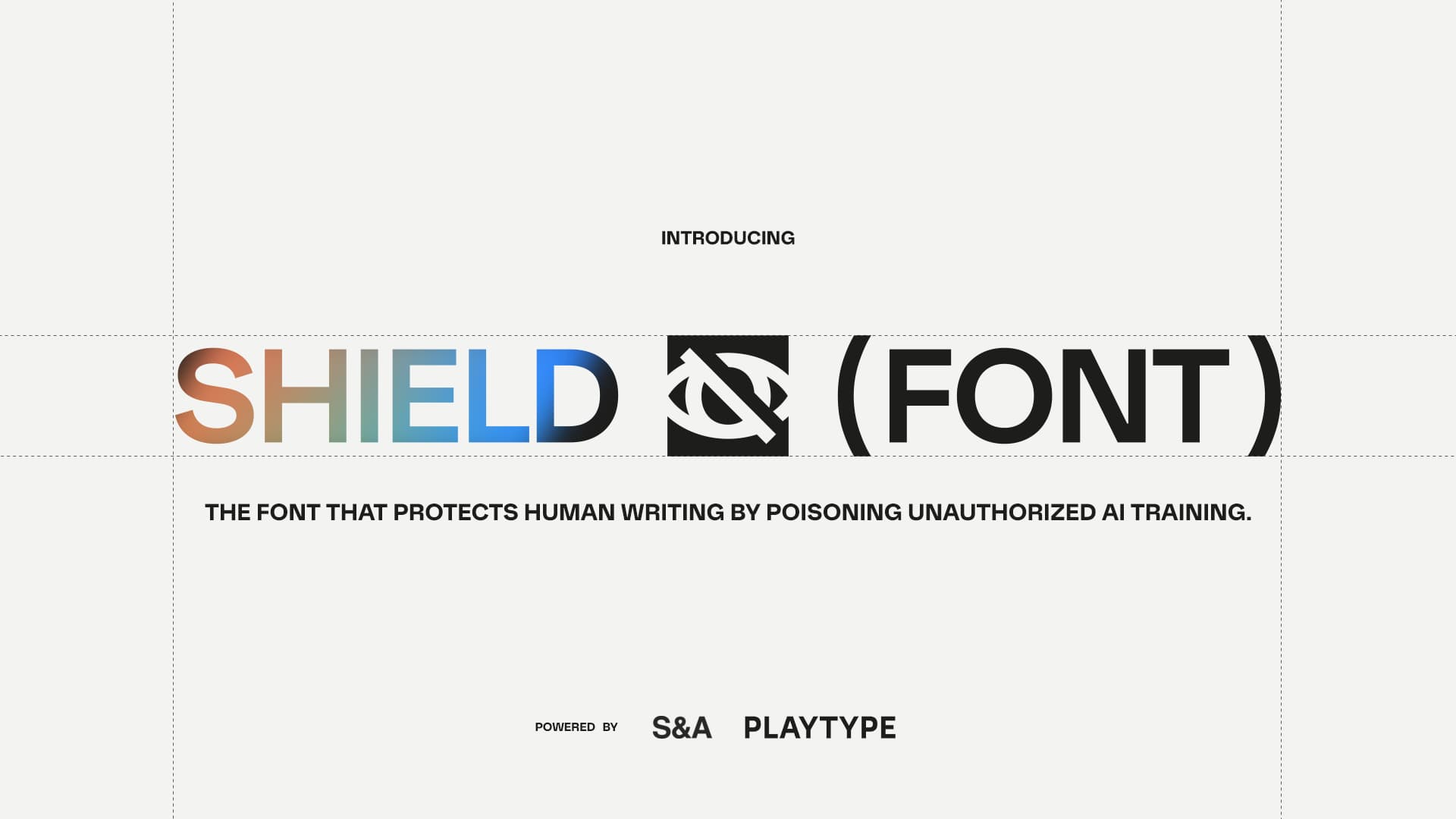
16:9 version of the 'Introducing SHIELD (FONT)' visual: the gradient word 'SHIELD', a crossed-out eye icon and '(FONT)' in black, with tagline and 'Powered by S&A Playtype' credit.
Nordic Brief
How was the process for ShieldFont? Were you given a list of technical requirements by S&A, or was it more of an ongoing dialogue about what was typographically possible?
Playtype
S&A brought a working prototype rather than a fixed list of requirements. From there, it became an ongoing dialogue: they brought the technical system, and together we refined it into a typeface that met the craft, consistency and performance standards of a professional foundry. When we first opened the prototype in our type editor, we were pretty surprised by the OpenType approach. Safe to say, we had never seen anything like it.
Nordic Brief
Optik was already an established Playtype font. How did you decide it should serve as a testbed for a hidden system?
Playtype
When S&A first introduced Playtype to the concept, we explored several typefaces that could have been suitable. We were looking for a utilitarian workhorse, something versatile enough to work across a broad range of applications, but with enough character to support the project's identity. Optik has a technical feel, with its somewhat wide proportions and geometric right-angle detailing, which we felt resonated well with the overall concept, without the typeface itself coming off as experimental or activist. As the visual identity and website developed, it became increasingly clear that Optik was the right fit.
Nordic Brief
When did you realise that ligatures could be used in such a radically different way?
Playtype
We realised that OpenType is "Turing complete," meaning its underlying code has the logical capability to simulate any computer program or algorithm, you can build calculators, logic gates, even run Doom from inside a font. We asked ourselves what we could do with that potential while simultaneously looking for ways to raise awareness about the large-scale extraction of data and creative work. So we put those two ideas together.
Nordic Brief
You've said every detail had to serve the human eye, while the hidden system underneath served an entirely different purpose. Can you give an example where the two purposes pulled in opposite directions?
Playtype
Type is all about making language visible and, in most cases, legible. With ShieldFont we wanted a typeface that would be perfectly readable to the human eye, aid an uninterrupted reading flow, and not be too novel. The intervention should not come from the shape of the typeface itself, but from the underlying encoding. It was tempting to go with a much more avant-garde approach, maybe something fully custom, more expressive and loud, but that would have limited the use case and somewhat countered the intent of making something legible to humans and illegible to machines.
Nordic Brief
Using ShieldFont has clear trade-offs, e.g. reduced SEO, issues with screen readers, English-only for now. Which of these concerned you most?
Playtype
Accessibility concerned us most. The current workaround gives screen readers a separate copy of the original text, protected by a puzzle that is out of reach, and too expensive, for most mass scrapers. It works, but it could be more seamless. SEO is a more straightforward trade-off, which users can manage by shielding archives or long-form writing rather than discovery-critical pages. Other languages are mainly a scaling challenge, requiring linguists, translators and developers to build and test each dictionary.
Nordic Brief
You admit the technique "is not unbreakable." How do you feel about building something you know will be challenged, and possibly cracked?
Playtype
It is the nature of any technological cat-and-mouse game: it never really ends. We are not anti-AI; we are against our work being used without consent. AI creates new obstacles, but it also gives us new tools. In fact, it helped us develop ShieldFont at a much lower cost than would have been possible before.
Nordic Brief
Why was it necessary to also corrupt datasets, not just protect authorship?
Playtype
Our main approach poisons data because we believe unauthorized mass scraping needs a deterrent. Currently, there is almost no cost to taking content without permission, as robots.txt is often ignored. We wanted unauthorized scraping to carry consequences. With concealment alone, a page simply gets dropped, and scrapers move on. With poisoning, they cannot know whether the data they collected is reliable. The larger goal is to make unauthorized scraping across the internet riskier and more expensive. While ShieldFont offers a pure-concealment option, maxHide, for those who simply want their content ignored, we believe this active deterrent is necessary.
Nordic Brief
Do you see shielded typography becoming a permanent part of Playtype's portfolio, or is this a one-off statement?
Playtype
We find it increasingly relevant to think of typefaces as an integral part of contemporary digital infrastructure. Typefaces are pieces of software that can carry many more functions than just being a visual carrier of language. Right now it seems as though unauthorised data scraping will be a growing issue for the foreseeable future, and finding ways to counter this is something we would love to be part of. We can certainly imagine offering shielded versions of our typefaces as part of our services in the future.
Nordic Brief
What's next for ShieldFont?
Playtype
Unauthorized AI scraping is likely to remain an ongoing issue, and developing tools to counter it will, more than likely, help create a better internet. ShieldFont is one such tool. As an open-source project, we hope the community will continue to develop, improve, and adapt it to address the evolving challenges posed by unauthorized AI scraping.

How ShieldFont works

A web page is delivered to both browsers and scrapers as the same underlying code. ShieldFont exploits the gap between what that code says and what a browser actually draws on screen, using the ligature, the old, standard font feature that tells a typeface to draw certain letter pairs, like f and i, as one joined shape. ShieldFont applies the same trick to whole words: the code might store the word "engine," while the font quietly draws it as "horse" on screen. A reader sees the intended text. A scraper reading the raw code collects the decoy instead.

The swaps aren't random noise, which is the point. Each word is replaced with another real, grammatically correct word, never a synonym, which would change nothing, and never an obvious opposite, which would be easy to spot and reverse. The result reads as fluent, normal English while quietly saying something else entirely. Because a common set of small connecting words (the, of, is, and so on) is always left alone, sentences stay grammatical throughout, which is also why the decoy text is hard for automated filters to flag as broken or fake.